
When Perimenopause Makes Your Ears Itch
An Irritation No One Adds to the Perimenopause Brochure

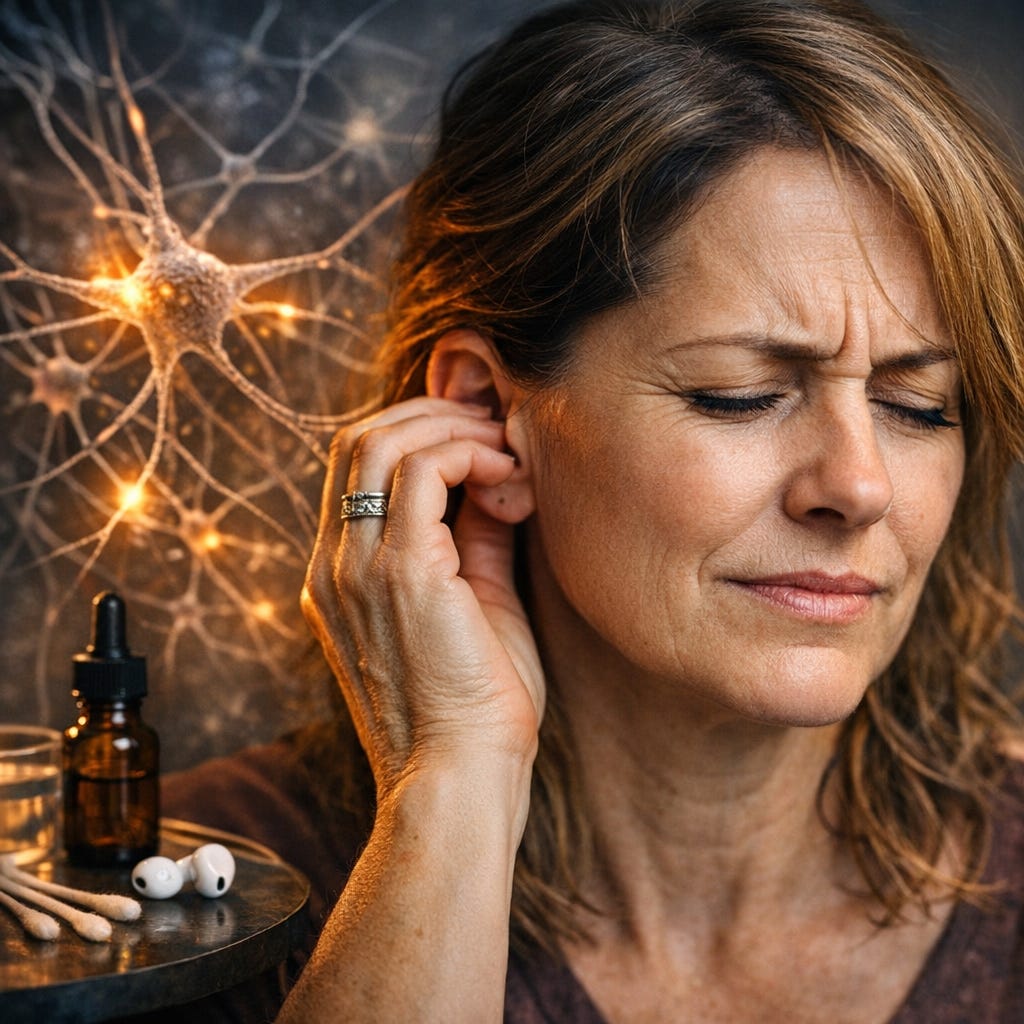
Some symptoms do not announce themselves. They irritate their way into the centre of your attention.
You might not speak about this.
You might notice yourself touching the outside of your ear more often, angling your head to one side, trying to settle an irritation that is difficult to reach and somehow even harder to explain. You might tell yourself it is nothing much. Dry skin. Shampoo. An overreaction. One of those odd little bodily nuisances that will disappear if you stop paying attention to it. But it does not disappear. It keeps returning, and because it is so specific and so unglamorous, you may begin dismissing yourself before anybody else has the chance.
That is often the most disorienting part of perimenopause. Not only that the body changes, but that it changes in ways that do not fit the script you were given. You were probably warned about hot flushes, missed periods, maybe night sweats, maybe mood shifts. You were probably not told that your skin might start behaving differently in small, maddening places. You were probably not told that the body can become less tolerant of friction, less buffered against irritation, and more likely to announce itself through details that sound too minor to matter until they start rearing their head each day.
An itchy ear operates exactly in this way. It sounds trivial, but it can be strangely intrusive. It can interrupt reading, conversation, work, sleep. It can become one more repetitive demand inside a time of life when all sorts is recalibrating. And because the symptom is not drastic, it can leave you feeling faintly foolish for noticing it so much. But the fact that a symptom sounds small does not mean the biology underneath it is small. Dry, itchy skin is a recognised part of the menopause and perimenopause picture, and current clinical guidance also notes that lower oestrogen can bring new skin sensitivities and dryness more broadly.
Thresholds
If you are trying to understand why your ears would have anything to do with perimenopause at all, it helps to stop thinking about this transition as a reproductive event with a few extra symptoms attached. Perimenopause is a whole-body neuroendocrine transition. Oestrogen does not limit itself to periods and fertility. It influences skin hydration, collagen, tissue resilience, blood vessels, mucosal surfaces, and aspects of how the brain and body regulate sensation. When it fluctuates and declines, the effects are distributed. They do not stay in their own lane, they blur outwards.
That matters because your ear canal is lined with very thin skin. That skin depends on moisture, protective oils, and an intact barrier. When tissue becomes drier and less resilient, irritation becomes easier to provoke. A surface that once tolerated ordinary life without comment may start signalling. Hair products, earbuds, hearing aids, earrings, water, soap, even habitual cleaning can become more noticeable against tissue that has lost some of its old tolerance. Ear eczema guidance from the National Eczema Society describes the ear canal and surrounding ear skin as vulnerable to dryness, itching and irritation, which can be made worse by scratching and contact irritants.
This is why I think the more useful frame is a threshold concept rather than symptom list. Perimenopause often lowers the threshold at which the body starts reporting friction. Your skin may react faster. Your sleep may break more easily. Your patience with sensory discomfort may shrink because your nervous system is already doing more work. So the itchy ear is not only a local event. It can be one expression of a broader shift in how much irritation your body is willing to absorb in silence.
Why It Feels So Intense
The problem is not simply that the ear itches. The problem is how insistently it recruits your attention.
That is where neurobiology matters. Itch, or pruritus, is not just a skin complaint. It is a sensory alarm. It is carried by specialised nerve fibres, including C fibres and some A-delta fibres, which signal to the nervous system that something at the body’s boundary may be dry, inflamed, irritated, or otherwise disturbed. Itch processing also involves spinal pathways and multiple brain regions, which is why the experience is not merely local. It becomes cognitive and emotional as well as physical.
This is why such a small sensation can become so consuming. Your brain does not assess a signal by how socially respectable it sounds. It assesses it by salience. A repetitive itch in a confined, hard-to-ignore area keeps getting promoted to the foreground because the nervous system treats it as relevant. The signal arrives. Your attention narrows. The urge to scratch rises. You touch or scratch for relief. Relief comes, but only briefly. Then the tissue is a little more irritated, and the cycle begins again.
That loop matters. Chronic itch is not only a skin problem. It is a skin-brain loop. Current reviews describe itch as a process shaped by peripheral nerve activation, immune signalling, and central sensitisation, where the nervous system becomes more responsive to repeated itch signals over time. That is part of why persistent itch can start taking up disproportionate mental space. It is a nervous system doing exactly what it was built to do with repeated sensory warning signals.
If you have found yourself irrationally preoccupied by something that sounds minor on paper, it means a repetitive sensory alarm has found a way into your attentional system, and attention is one of the ways symptoms grow.
The Skin Barrier Is Part of the Story
It helps to think about the skin not as packaging but as a living border. The skin barrier keeps moisture in and irritants out. When it is functioning well, the body tolerates contact relatively easily. When it becomes compromised, ordinary exposures can start producing disproportionate discomfort.
The National Eczema Society describes several forms of ear eczema, including contact dermatitis and asteatotic eczema, the latter being a dryness-associated eczema that is more common in older adults. Their guidance notes that itching, flaking, soreness and irritation can all occur in the ear and ear canal, and that self-treatment with scratching or objects in the ear can worsen the problem.
That is useful because it widens the picture beyond a vague idea of hormones alone. Perimenopause may be part of why the tissue is drier and more reactive, but the actual itch can also be shaped by the state of the skin barrier, local inflammation, allergy, eczema tendencies, trapped moisture, and contact irritation from products or devices. The body is rarely neat enough to offer one single cause.
This is one reason women can feel confused. The symptom belongs to several systems at once. It is hormonal, dermatological, sensory and behavioural. That complexity is real. You are not imagining it just because it refuses to fit into one tidy explanatory box.
Why It Can Get Worse When You Try to Fix It
One of the crueller features of itch is that the body’s instinctive response can prolong the problem. Scratching, rubbing, and putting objects into the ear canal can damage the thin skin there, remove protective wax, and increase irritation. NHS guidance on ear infections advises against putting fingers or cotton buds into the ears, and earwax guidance from ear, nose and throat specialists similarly warns that cotton swabs can injure the canal and push wax deeper rather than solving the problem.
That protective wax matters more than many people realise. Earwax is not dirt. It helps lubricate the canal, repel water and protect against infection. When you repeatedly remove it, especially from already dry or irritated tissue, the canal can become more vulnerable rather than more comfortable.
As alluded to before, there is a neurobiological layer here too. Scratching gives a burst of relief because it momentarily changes the sensory input the brain is receiving. That relief is real, but brief. Then the tissue is left a bit more inflamed, and the itch signal returns. Over time, the brain can learn the pattern: itch, scratch, relief, itch again. That is part of why persistent itching can become such an efficient habit loop.
So if you have been trying to solve the problem by cleaning the ear more, scratching it more, or “just checking” it more often, it is very possible you are caught in the exact loop that keeps it going.
What You Can Do About It
The first thing to say is that not every itchy ear in perimenopause needs a dramatic intervention. Often what helps is reducing irritation, protecting the skin barrier, and treating the ear canal as delicate tissue rather than a problem to be aggressively managed.
Start by stopping the things most likely to keep the loop going. Do not put cotton buds, fingernails, hair grips or any other objects into the ear canal (I need to practice what I preach here!) Multiple NHS and ear, nose and throat sources warn against this because it can injure the canal, worsen irritation and interfere with protective wax.
Try reducing potential irritants around the area. If your symptoms flared around the time you changed shampoo, hair dye, skincare, earbuds, earrings, hearing aid products or ear drops, that detail matters. Ear eczema guidance specifically lists contact dermatitis as one cause of ear irritation, so it is worth thinking in terms of what the tissue is touching, not only what your hormones are doing.
Keep water and soap out of the canal as much as you reasonably can. NHS sources on outer ear problems recommend avoiding water, shampoo and soap in irritated ears, and several NHS hospital leaflets suggest using cotton wool coated with petroleum jelly in the outer ear bowl during showers if keeping water out is difficult.
If the dryness is mainly at the entrance to the ear rather than deep inside, some NHS advice suggests moisturiser around the bowl of the ear and the entrance to the canal, rather than putting products deep into the ear yourself.
If the itch seems linked to eczema or inflammation, a pharmacist or clinician can advise whether you need treatment such as steroid ear drops or other topical therapy. Ear eczema guidance notes that treatment may include medical emollients, topical steroids and management of infection when present, but the correct product depends on where the eczema is and whether there is infection or a damaged eardrum, which is why it is better not to self-prescribe random drops.
If you think wax build-up is part of the problem, it is worth getting that assessed rather than trying to remove it yourself. Impacted wax, eczema, infection and dryness can all produce itch, fullness or discomfort, and the management is not the same for each. Earwax guidelines recommend professional assessment and, where needed, safe removal rather than home probing with swabs or sharp objects.
When to Get It Checked
Because perimenopause can make this symptom more understandable, there is a temptation to fold everything into hormones. That can be reassuring up to a point, but it should not stop you getting an ear checked when the pattern suggests something more than dryness or mild irritation.
You should seek medical advice if the itching is persistent, painful, associated with discharge, bleeding, swelling, hearing loss, dizziness, fever, a blocked sensation that is getting worse, or visible rash and cracking that are not settling. NHS ear infection guidance advises medical review when ear symptoms are severe, persistent, worsening, or accompanied by discharge or hearing problems.
That matters because itchy ears can sometimes reflect otitis externa, contact allergy, psoriasis, seborrhoeic dermatitis, fungal issues, or wax problems rather than simple hormonally amplified dryness alone. Perimenopause may be the terrain, but it is not always the whole diagnosis.
It’s Not Unusual
If your ears have started itching during perimenopause, you are not imagining a bizarre symptom that nobody else has had. You are living at the intersection of skin, hormones, nerves and thresholds. Oestrogen shifts can leave tissue drier and less resilient. Irritants can land harder. The nervous system can amplify a repeated itch signal into something that takes up more space than its size would suggest. Ear eczema, contact irritation, moisture and over-cleaning can all make the picture worse.
Perimenopause does not only change your cycle. It changes your surfaces, your thresholds, your tolerance for friction, and the way the nervous system handles repeated interruption. Sometimes the ears are simply one of the places where that truth becomes impossible to ignore.
Paid subscribers can access the resource: Perimenopause Itch and Irritation guide at the end of this article.
Want to Go Deeper?
Menopause is not just about managing symptoms, it’s about understanding the profound transformation happening within you.
If you’re looking for guidance on managing menopause symptoms through holistic healing, mindset shifts, and practical solutions, my Mapping Menopause Online One day workshop provides the tools you need to embrace this transition with confidence and ease. Click on the image below to find out more.
Somatic techniques & breathwork to work with your body, not against it.
Mindset shifts to transform menopause from struggle to empowerment.
Holistic tools for balancing hormones, reducing stress, and reclaiming energy.
Your body isn’t breaking, it’s awakening.

I was recently a guest on ‘Clueless in the Pause’ talking about all things menopause and mental health - have a listen here by clicking the image below:

An Invitation to Share
Feel free to comment or reach out; your story can offer comfort and solidarity to others on this ride.
If you don’t want a regular commitment but would like to contribute to me helping others then click below to buy me a coffee!
If you would like to read other areas that I write upon I invite you to check out my Rewrite Room where a collection of my most recent articles can be found. Click the image below to enter.

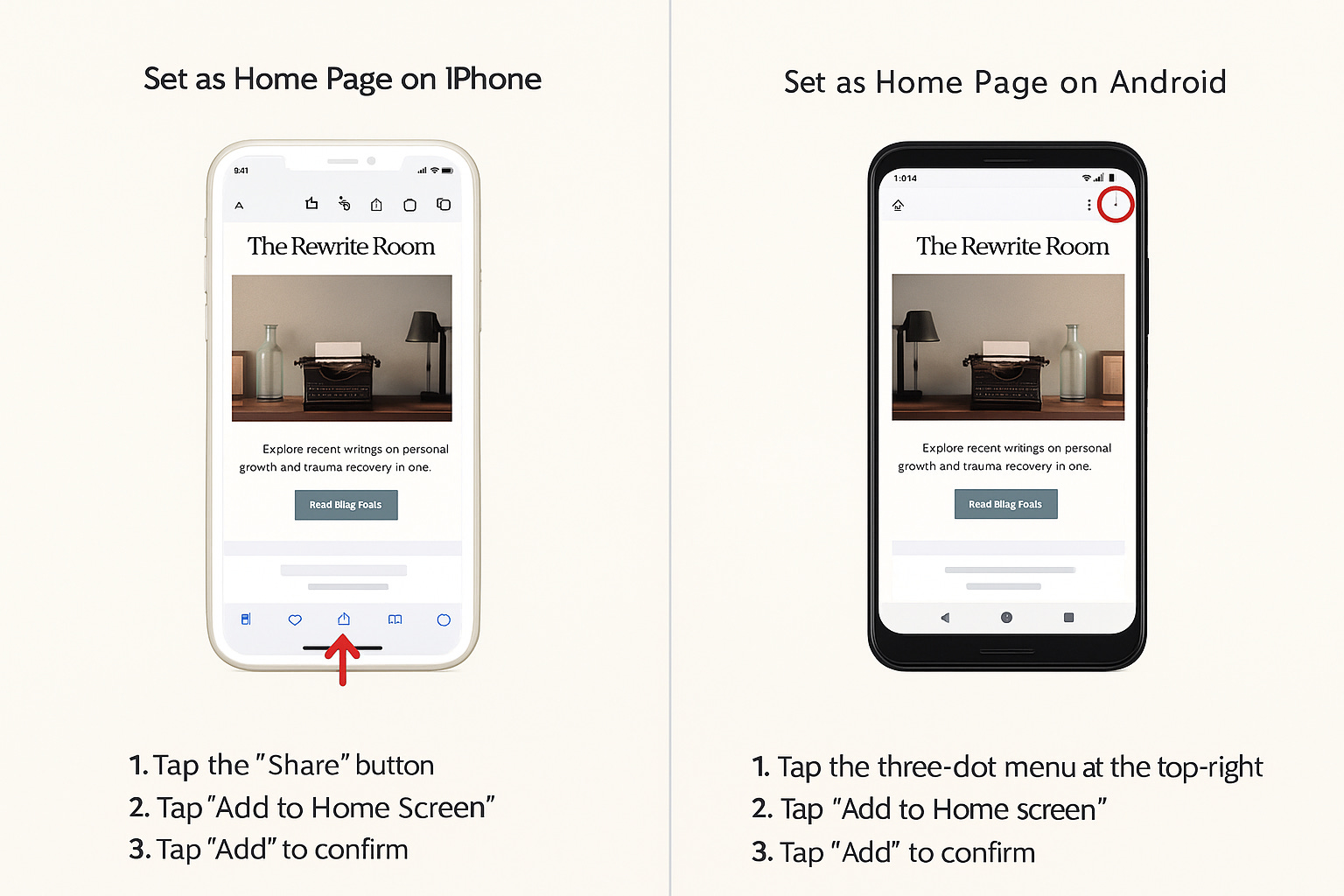
The Rewrite Room is the easiest place to find all of my recent writing in one grounded space. Every new article I publish on Substack and Medium arrives here automatically, so you always have a single doorway to return to. If you enjoy reading my work and want an easy way to reconnect without searching through apps or platforms, you are welcome to keep this page close. Many readers choose to make it their home screen so they can step into this space with one tap. Below is a simple guide on how to do that on iPhone and Android.
I recently spoke about the importance of learning to work with your nervous system, which includes grounding, on UK Health Radio - click the image below to listen.

If you feel you want to try some meditations to help you reconnect with your body which can really help when trying to set boundaries, as you can learn to feel when something does and does not serve you. Click the images below to find out about the specific focus of each. All my meditations use healing frequencies, subliminal messages and binaural beats to enhance recovery - if these terms feel meaningless click, the images to find out more.


For media enquiries please see my press page